
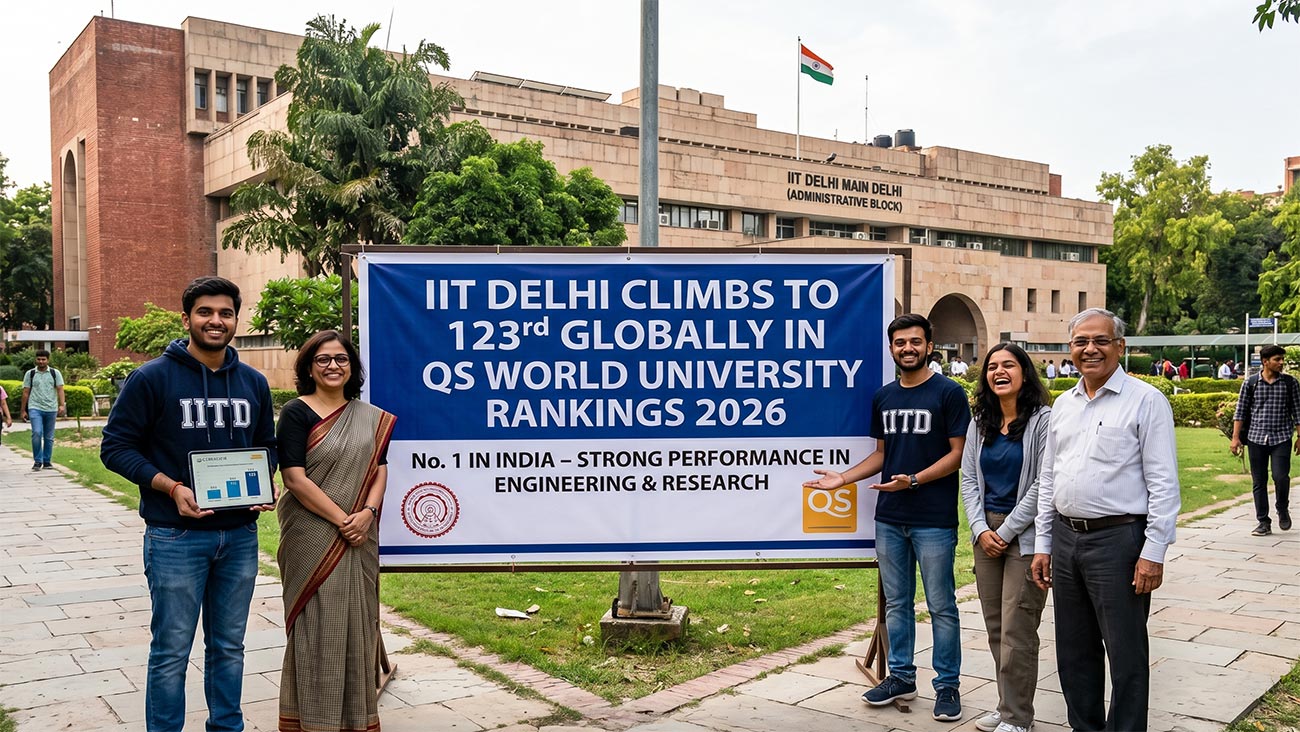
New Delhi, April, 2026 – The Indian Institute of Technology Delhi (IIT Delhi) has achieved a significant milestone by climbing to the 123rd position globally in the QS World University Rankings 2026. This marks a notable improvement of 27 places from its previous ranking of 150th in 2025, making it the highest-ranked Indian institution in the latest edition of the prestigious rankings.
IIT Delhi secured an overall score of 65.5, with particularly strong performance in academic reputation (67.9) and employer reputation. The institute also excelled in several subject rankings, breaking into the global top 50 in multiple engineering and technology disciplines. It retained its position as India’s top institution in Engineering & Technology with a global rank of 36.
According to QS, the rise is attributed to consistent improvements in research output, citations per faculty, and international collaborations. IIT Delhi has intensified its focus on emerging areas such as artificial intelligence, sustainable technologies, quantum computing, and interdisciplinary research, resulting in higher global visibility and impact.
Other Indian IITs also performed well. IIT Bombay ranked 129th, while IIT Madras stood at 180th. A record number of Indian institutions featured in the QS rankings this year, reflecting the growing quality and international recognition of Indian higher education.
Union Education Minister Dharmendra Pradhan congratulated IIT Delhi and other Indian institutions on their performance. “This upward trajectory validates the reforms under National Education Policy 2020 and the sustained efforts of our premier institutions towards excellence,” he stated.
IIT Delhi Director Prof. Rangan Banerjee expressed pride in the achievement and credited the collective efforts of faculty, students, and alumni. He emphasised that the institute remains committed to further enhancing research quality, faculty strength, and global partnerships.
Education analysts view this ranking improvement as a positive signal for India’s ambition to become a global education hub. However, they noted that challenges such as faculty shortages, infrastructure expansion, and greater international student diversity still need to be addressed to compete with top global universities.
The QS World University Rankings 2026 evaluated over 1,500 institutions worldwide based on 9 key indicators, including academic reputation, employer reputation, faculty-student ratio, citations, and internationalisation.