
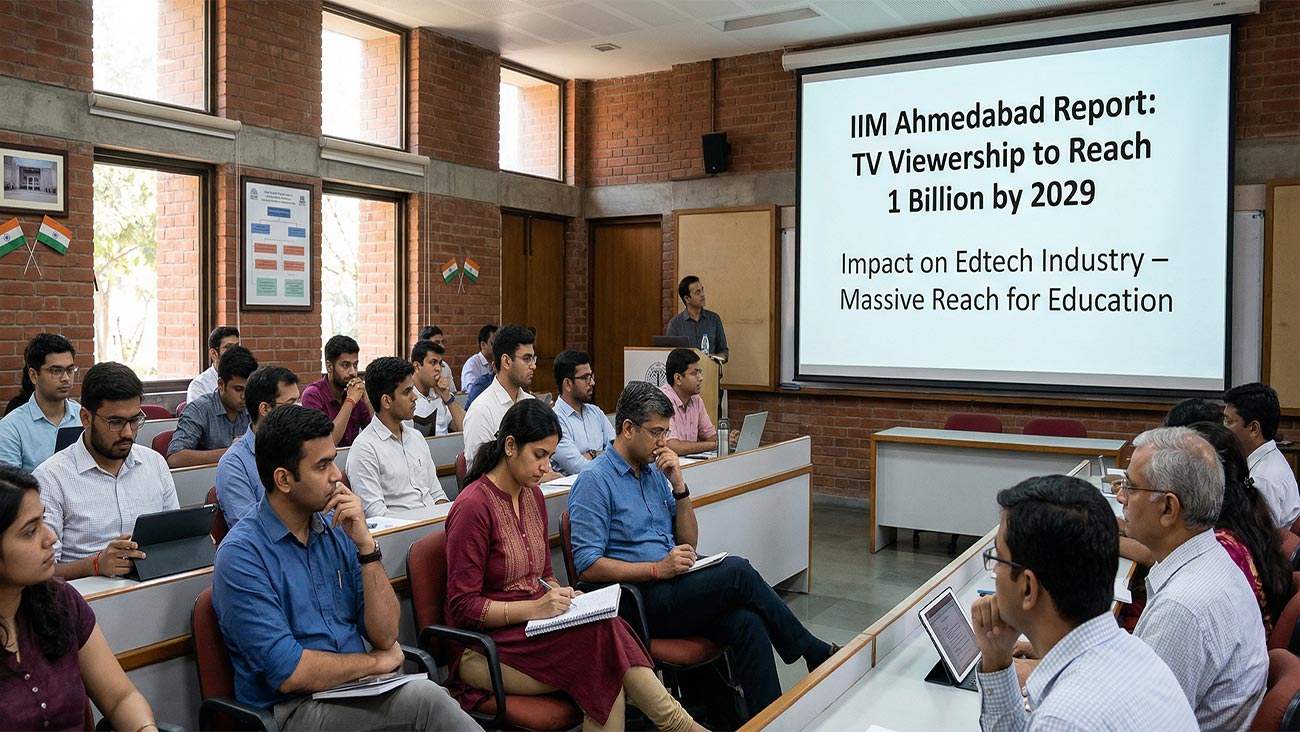
A latest report by the Indian Institute of Management Ahmedabad (IIM-A) has projected that television viewership in India will cross the one billion mark by 2029, posing both opportunities and challenges for the fast-growing edtech sector.
The report titled “Media Consumption Trends in India 2026-2030” estimates that TV will remain the dominant medium for mass reach even as digital platforms continue to expand rapidly. With rural penetration increasing and affordable smart TVs becoming widespread, the study forecasts that by 2029, India’s TV audience will touch 1 billion viewers, up from the current estimated 900 million.
IIM Ahmedabad researchers noted that while digital video consumption is growing at 18-20% annually, television still commands higher daily viewing time (average 3.8 hours per household) compared to OTT platforms. The report highlights that in Tier-2 and Tier-3 cities and rural areas, TV continues to be the primary source of information and entertainment.
The massive TV reach is expected to significantly impact the edtech industry. Experts believe that edtech companies may increasingly partner with television channels and broadcasters to deliver educational content through linear TV, especially for government schemes like PM e-VIDYA, DIKSHA, and SWAYAM. Traditional broadcasters could also launch dedicated education channels or edutainment slots targeting school and college students.
“Television’s unparalleled reach makes it a powerful tool for inclusive education. Edtech players who ignore TV may miss a large segment of learners in smaller towns and villages,” said Prof. Arindam Banerjee, one of the lead authors of the report at IIM Ahmedabad.
The forecast comes at a time when many edtech unicorns are facing funding winter and profitability pressures. Industry observers say the report may push edtech firms to diversify their delivery models beyond app-based learning and explore hybrid TV-digital strategies.
The IIM-A study also predicts that by 2030, a significant portion of government-funded educational broadcasting will shift towards vernacular languages to improve learning outcomes in non-metro regions.
The report recommends stronger collaboration between edtech companies, broadcasters, and policymakers to leverage television’s massive scale for achieving the goals of the National Education Policy 2020.