
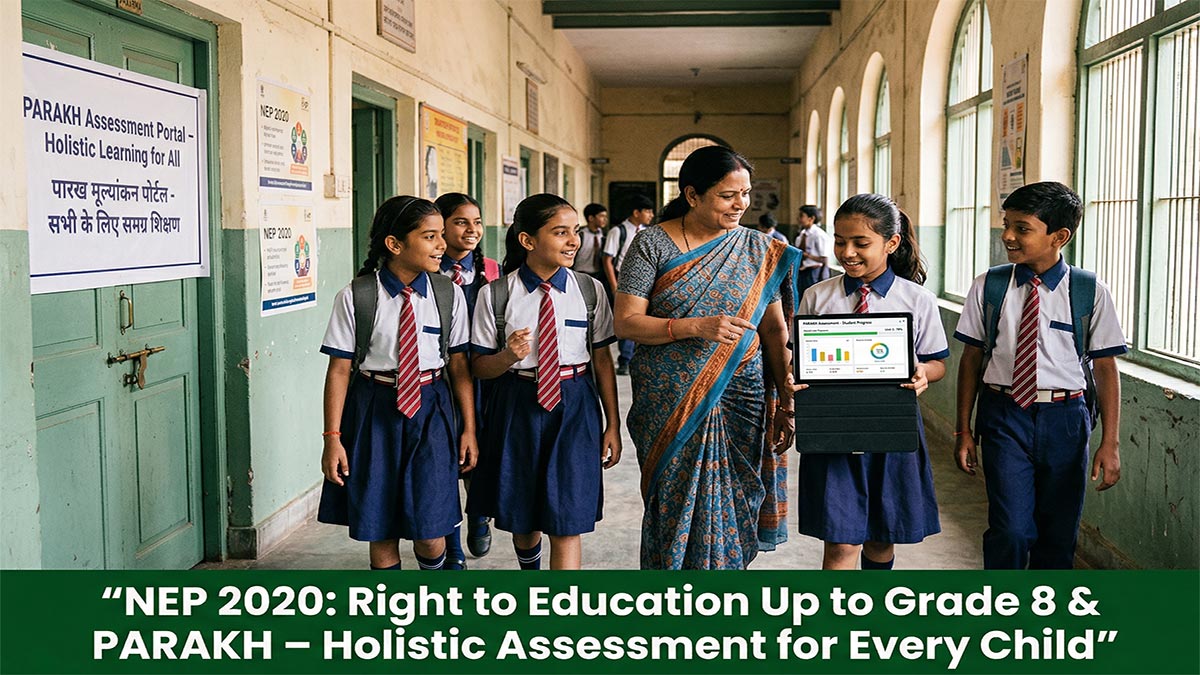
New Delhi, March, 2026 – The Union government has rolled out two major NEP 2020–aligned reforms aimed at strengthening equitable, continuous learning in India: amendments to the Right of Children to Free and Compulsory Education (RTE) Act that bar expulsion of students up to Grade 8, and the nationwide launch of the PARAKH (Performance Assessment, Review, and Analysis of Knowledge for Holistic Development) assessment portal. Together, the moves signal a shift from punitive discipline and marks‑centric evaluation toward support‑driven, holistic schooling.
No expulsions up to Grade 8
The proposed amendments to the RTE Act, already cleared by the Union Cabinet, prohibit any school—government, aided, or recognized private—from expelling a child from Class 1 to Grade 8, regardless of behavior or academic performance. In cases of serious misconduct, the policy mandates age‑appropriate counseling and special remedial programs instead of denial of education.
The change is designed to align with NEP 2020’s emphasis on universal access, retention, and “no hard separation” between vocational and academic streams in the early years. Education officials say the amendment will help reduce drop‑out rates, especially among marginalised groups, and push schools to adopt restorative‑justice‑style approaches rather than punitive measures.
PARAKH portal for holistic assessment
Parallel to the RTE amendments, the Ministry of Education has officially launched the PARAKH portal, a national assessment framework that replaces traditional one‑time exam scores with continuous, competency‑based evaluations. The portal enables schools to conduct periodic assessments, upload student performance data, and generate skill‑wise dashboards for teachers, parents, and policymakers.
Under PARAKH, students are assessed across cognitive, emotional, and social domains, including critical thinking, creativity, collaboration, and communication, rather than only paper‑based marks. The system is being piloted in select CBSE and state‑board schools before full‑scale rollout, with plans to integrate it with teacher‑training modules and digital classrooms under NEP 2020.