
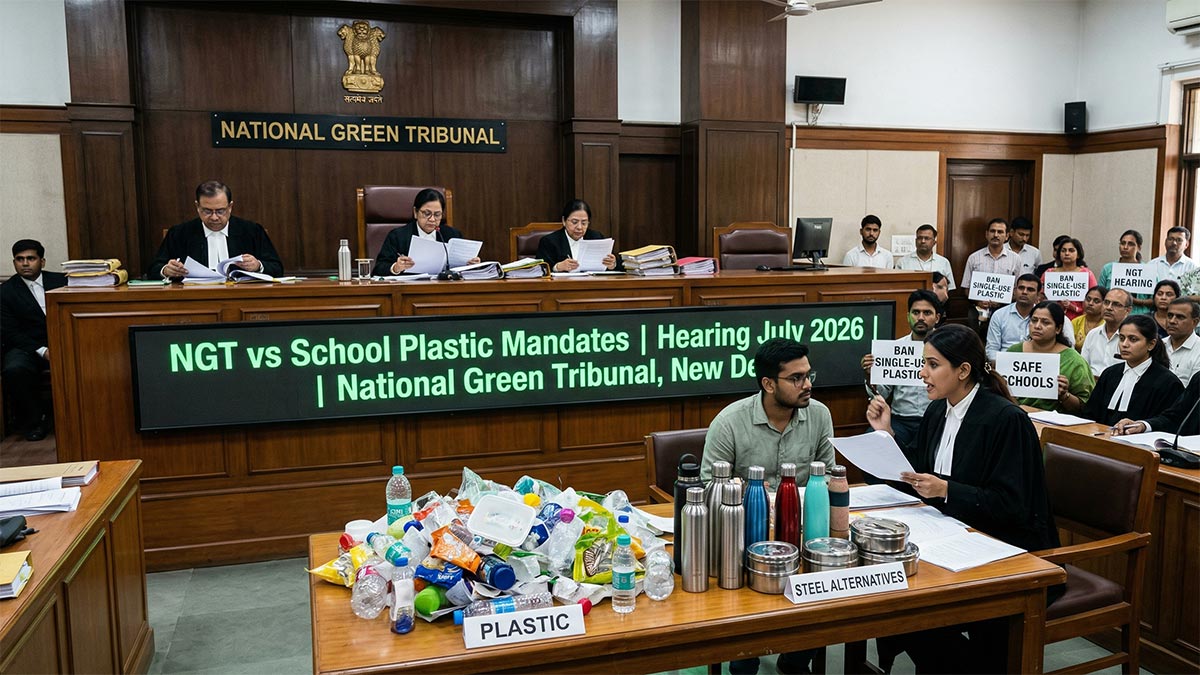
New Delhi, April, 2026: The National Green Tribunal (NGT) has taken serious cognisance of a private school’s mandate restricting students to plastic water bottles while banning metal alternatives, citing grave health and environmental risks posed by microplastic leaching. A bench headed by Chairperson Justice Prakash Shrivastava, along with Expert Member Dr. Afroz Ahmad, is overseeing the suo motu proceedings initiated on the basis of a January 18 news report titled “Parents object to metal water bottle ban at private school.”
In its earlier order dated January 20, the NGT observed that plastic bottles commonly leach microplastics, which can have adverse impacts on human health, particularly among young children. “Such an approach of schools would be detrimental to the young children,” the tribunal noted, emphasising that the policy raises substantial questions relating to compliance with environmental norms under the Water (Prevention and Control of Pollution) Act, 1974, and the Environment (Protection) Act, 1986.
During the latest hearing, counsel for the Central Pollution Control Board (CPCB) informed the bench that its reply had been filed. The tribunal directed the registry to examine and place the response on record if found defect-free. The Directorate of Education, Delhi government, appearing virtually, sought and was granted six weeks’ time to file its response. Noting the incomplete service of notice on the Delhi Pollution Control Committee (DPCC), the NGT ordered fresh steps for proper service.
The bench also impleaded Raghubir Singh Junior Modern School on Humayun Road, Central Delhi, as a respondent. Counsel for the school accepted notice and sought time to file a reply. The tribunal directed the preparation of an amended memo of parties incorporating the school.
The matter highlights growing parental concerns over school policies that allegedly prioritise plastic bottles, potentially exposing students to microplastics while contributing to plastic pollution. Environmental experts have long warned that repeated use of plastic bottles can release harmful particles into drinking water, affecting children’s developing systems.
The NGT’s intervention underscores the need for schools to align with sustainable practices and prioritise safer alternatives like stainless steel or glass bottles that minimise environmental harm and health risks. Authorities must now address whether such mandates violate broader pollution control frameworks and child welfare standards.
The case has been listed for further hearing on July 8, when responses from all parties, including the newly impleaded school, will be examined. The outcome could set a precedent for regulating plastic use in educational institutions across the country, pushing for eco-friendly hydration practices in schools.