
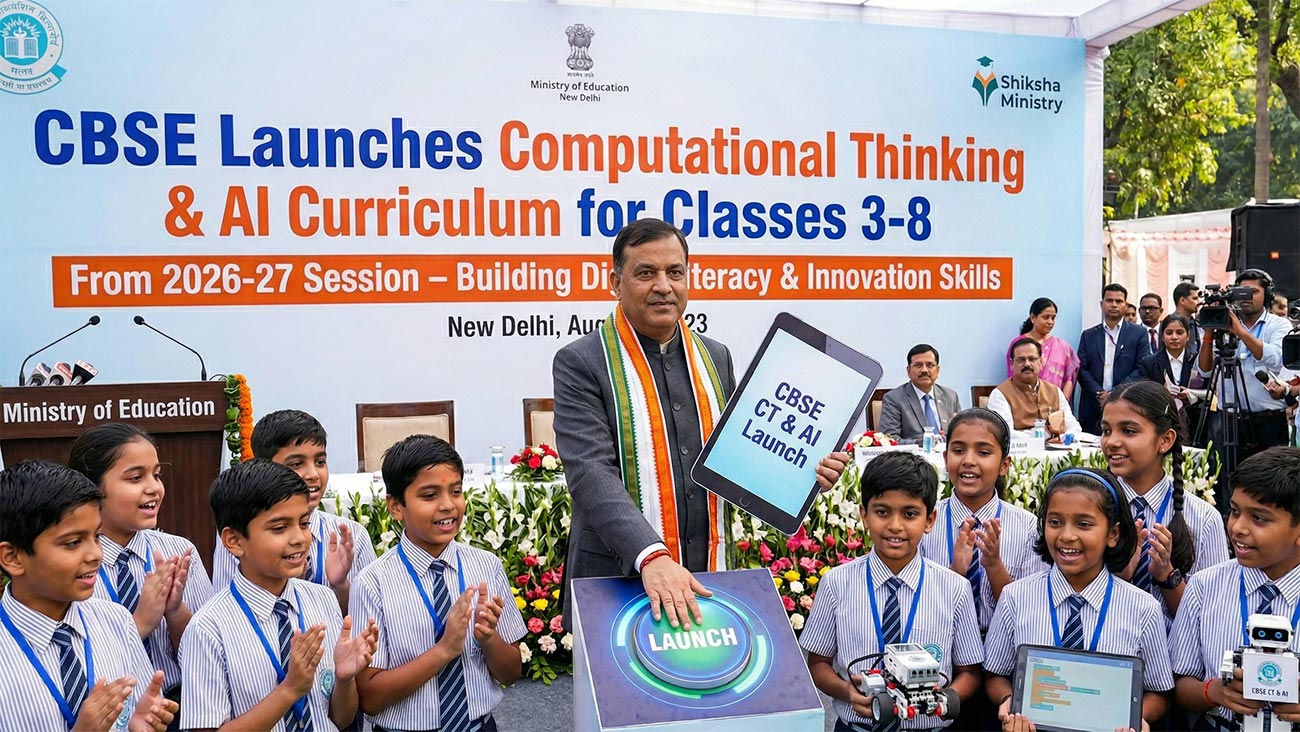
The Central Board of Secondary Education (CBSE) has officially launched a comprehensive Computational Thinking and Artificial Intelligence (AI) curriculum for students of Classes 3 to 8. Union Education Minister Dharmendra Pradhan formally flagged off the new framework, which will be implemented from the 2026-27 academic session across all CBSE-affiliated schools in India and abroad.
The initiative aims to build strong foundations in digital literacy, logical reasoning, and innovation skills from an early age. According to the minister, the curriculum is designed to prepare young learners for the rapidly evolving technological landscape and to foster a generation equipped with future-ready competencies. “This is a transformative step towards making Indian students globally competitive in the era of AI and digital innovation,” Pradhan stated during the launch event held at CBSE headquarters.
The new curriculum integrates computational thinking concepts such as algorithms, pattern recognition, abstraction, and decomposition into age-appropriate modules. For Classes 3-5, the focus will be on fun, activity-based learning through games, block-based coding, and simple robotics. In Classes 6-8, students will be introduced to basic programming, data handling, ethical use of AI, and introductory machine learning concepts. The framework emphasises hands-on projects, collaborative problem-solving, and real-world applications rather than rote learning.
CBSE officials highlighted that the curriculum has been developed in collaboration with leading experts from IITs, industry partners, and international education bodies. Special training programs for teachers have already been planned to ensure effective delivery. Necessary digital infrastructure guidelines have also been issued to schools to support the rollout.
Educationists have welcomed the move, calling it a much-needed reform aligned with the National Education Policy (NEP) 2020. “Introducing computational thinking and AI at the foundational and preparatory stages will nurture creativity and critical thinking among children,” said Prof. Anil Kumar, a senior education advisor. Parents expressed optimism that the curriculum will reduce the digital divide and equip their children with essential 21st-century skills.
The launch comes at a time when India is pushing aggressively towards becoming a global leader in AI and emerging technologies. The new subjects will be integrated into the existing timetable without increasing the overall academic burden, with assessment focusing on practical demonstrations and project work rather than traditional examinations.
Detailed guidelines, textbooks, and digital resources are expected to be released by June 2026. Schools have been instructed to begin preparatory workshops for teachers from the current session itself.
This bold initiative by CBSE and the Union Education Ministry is seen as a significant milestone in modernising school education in India. By embedding computational thinking and AI early, the board aims to create a strong talent pipeline for the country’s digital economy and innovation ecosystem.