
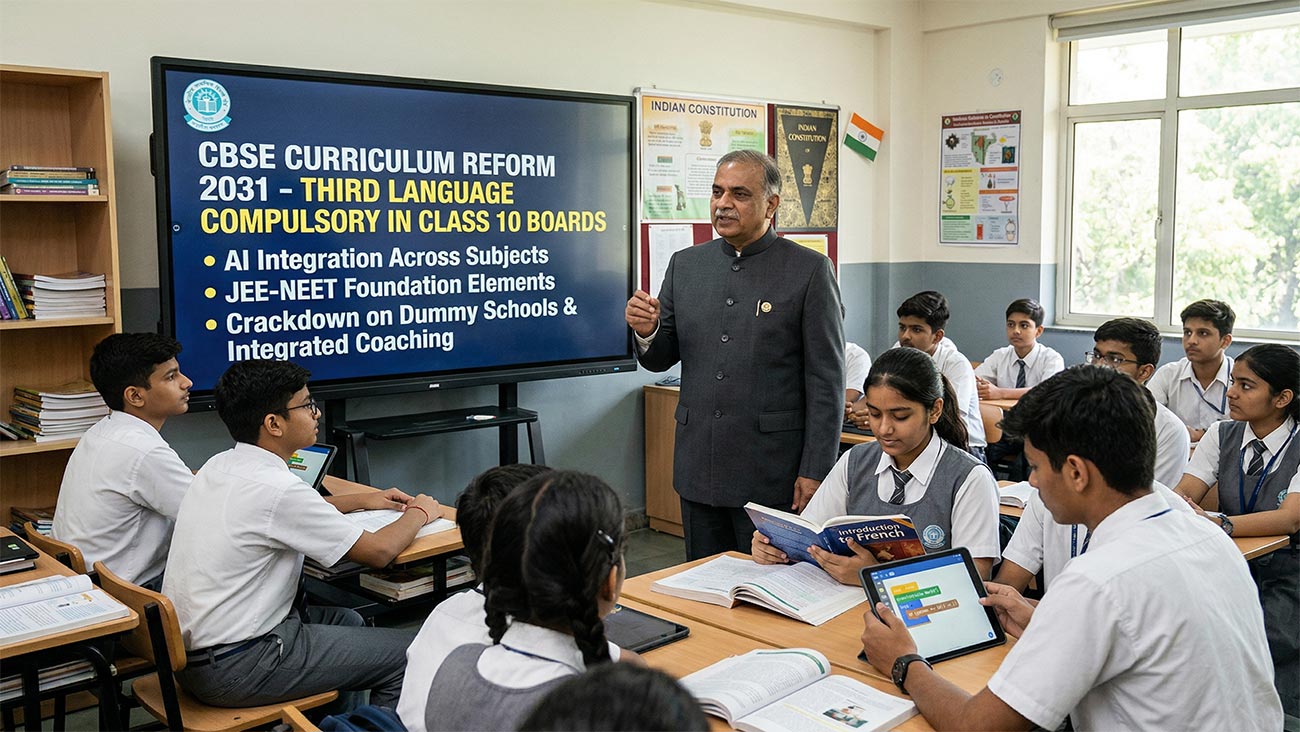
New Delhi, April, 2026 – The Central Board of Secondary Education (CBSE) has announced a sweeping curriculum overhaul that will make the study of a third language compulsory for Class 10 board examinations starting from the 2030-31 academic session. The landmark decision forms part of a broader reform aimed at strengthening multilingualism, technological readiness, and academic rigour among Indian students.
Union Education Ministry sources confirmed that students will be required to clear a third language paper — in addition to Hindi and English — as a mandatory subject for Class 10 boards by 2031. The move is aligned with the National Education Policy (NEP) 2020’s emphasis on promoting linguistic diversity and cognitive development. Schools will offer choices including regional languages, foreign languages, or classical languages such as Sanskrit, Tamil, or Persian.
The reform package also includes deeper integration of Artificial Intelligence (AI) and computational thinking across secondary classes. From the 2027-28 session, select AI modules will become part of the core curriculum, building on the recently launched Computational Thinking programme for Classes 3-8. Additionally, elements of JEE and NEET preparation, such as advanced problem-solving modules in Mathematics, Physics, and Biology, will be introduced in Classes 9 and 10 to reduce dependence on external coaching.
In a significant crackdown on malpractice, the CBSE has vowed strict action against “dummy schools” — institutions that enrol students only for board examinations without providing regular classes. New guidelines will mandate minimum attendance of 75 per cent, regular internal assessments, and physical verification of infrastructure. Schools found violating norms will face disaffiliation and legal action.
“These changes will create well-rounded, future-ready students while curbing unethical practices that undermine the education system,” said a senior CBSE official. Education experts have largely welcomed the third language mandate, noting its potential to enhance cultural awareness and employability in a globalised world. However, some school principals have raised concerns about implementation challenges, particularly in resource-constrained regions and the additional burden on students already preparing for competitive exams.
The board plans to roll out teacher training programmes and updated textbooks over the next three years. Pilot programmes for the third language and AI integration will begin in select schools from the 2027 session to refine the framework before nationwide implementation.
This comprehensive reform signals CBSE’s commitment to modernising school education in line with NEP 2020 goals. By combining linguistic proficiency, technological skills, and stronger academic foundations, the board aims to reduce coaching dependency and produce graduates equipped for both higher education and the evolving job market.
Students, parents, and schools have been advised to stay updated through the official CBSE website as detailed notifications and syllabi are expected in the coming months.